How to use TheraMentor in your training programme
A practical guide: what you want to achieve, what you gain and how to fit it, step by step, into your programme.
Talk to us about your training programme1. The gap TheraMentor fills
Trainee therapists need more practice than classes and supervision can fit. TheraMentor fills exactly that gap: a space where they practise specific skills without needing an instructor's time on every attempt, and where every supervision session starts from concrete material.
Typical goals for a programme:
- more practice opportunities between classes and supervision,
- trainees who arrive at supervision with their own reflection and specific questions,
- a shared language for skills (empathy, active listening, professional boundaries, reflection, open questions),
- a safe space to make mistakes before working with real clients.
2. What it brings to your programme
Time: repetition happens without an instructor present for every attempt.
More meaningful supervision: meetings start from material (reflections, excerpts, questions) rather than from zero.
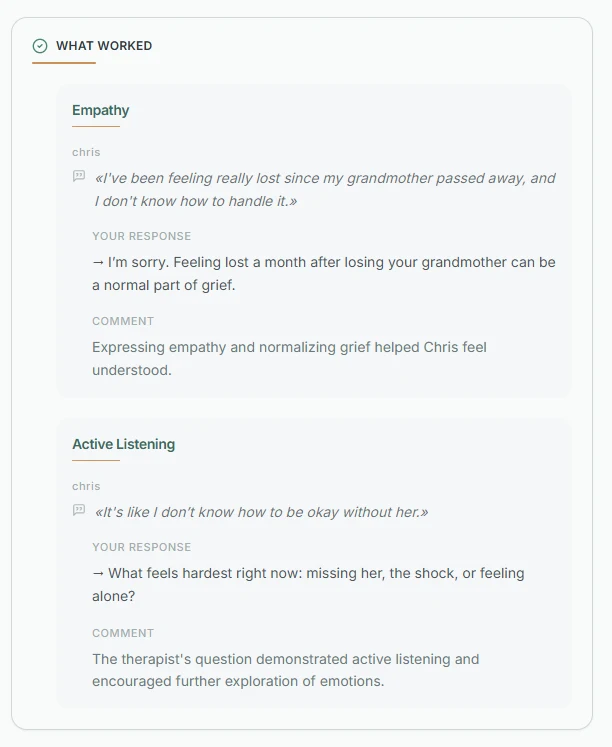
Consistency: every trainee gets feedback on the same criteria after each session.
Flexibility: practice in text or voice, whenever and wherever it suits the trainee.
Bridge to practice: working on cases with pseudonyms prepares trainees for real clinical work.
Humans stay in charge: TheraMentor suggests, the supervisor and trainee decide. TheraMentor's suggestions are kept apart from the trainee's own observations.
3. A 45-minute class with TheraMentor
20 minutes
Theory
The instructor presents a skill, e.g. active listening.
15 minutes
Practice
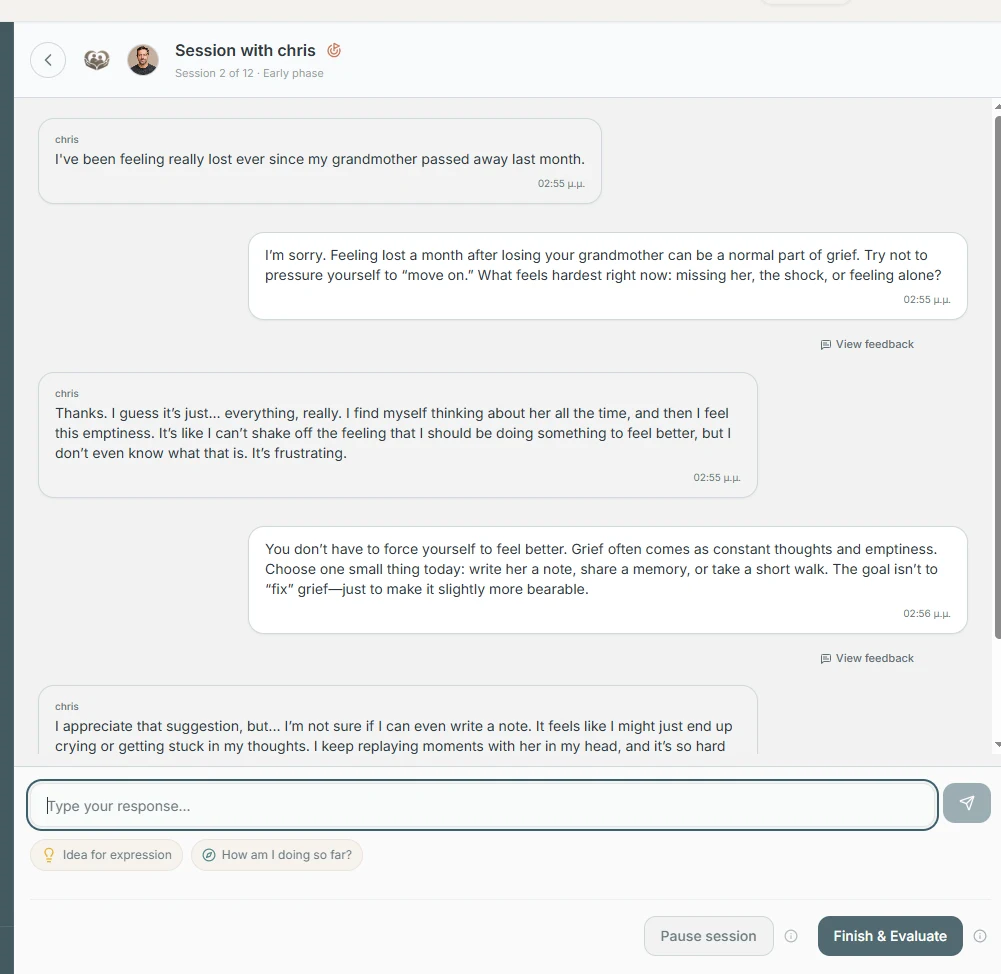
Trainees practise with a virtual client in TheraMentor.
10 minutes
Reflection
They discuss the experience, the difficulties and the feedback with the instructor.
4. How it fits your course: a 4-week pilot for 5–10 trainees
A ready-made example you can try with a small group.
What the pilot needs
1 skill · 5–10 trainees · 1 supervisor or instructor · 4 weeks
How much time it takes
Trainee: 1–2 short sessions a week (e.g. 15 minutes) plus a few minutes of reflection.
Supervisor/instructor: no time during practice; supervision starts from the reflection.
Week 1: getting to know it
- Each trainee runs a first virtual session with a virtual client of their choice.
- They read the feedback and write a short reflection.
Weeks 2–3: focused practice
- 1–2 short sessions a week on the skill being taught (e.g. open questions).
- Try a different approach or virtual client to see how the session changes.
- Anyone with a real case works on it in My Cases with a pseudonym and talks it through with the Mentor.
Week 4: bring it to supervision
- Each trainee brings a reflection and one point that troubled them.
- The supervisor uses it as a starting point and remains responsible for the educational interpretation.
After the pilot
- Talk with trainees: what helped, what didn't.
- Decide: continue, change the skill, or extend to another group.
5. What trainees and the supervisor do
Before
- Trainee
- Chooses virtual client and approach
- Supervisor / instructor
- Sets the skill and the context
During practice
- Trainee
- Runs sessions in text or voice
- Supervisor / instructor
- Does not need to be present
After
- Trainee
- Reads feedback, writes a reflection
- Supervisor / instructor
- Asks about the reflection in supervision
Progress
- Trainee
- Compares their reflections over time
- Supervisor / instructor
- Discusses development with the trainee
Cases
- Trainee
- Records with a pseudonym and talks to the Mentor
- Supervisor / instructor
- Supervises the case as usual
TheraMentor supports practice and educational feedback. It does not replace human supervision and does not certify clinical competence. Supervisors do not automatically see sessions; trainees bring to supervision what they choose.
6. How you will know it helps
After the 4 weeks, ask:
- Are reflections becoming more specific?
- Do trainees bring more focused questions to supervision?
- What do they say helped and what didn't?
- Do they use it without being reminded?
If you see none of these, there's no need to continue.
7. How we start
- You send us a short email, even if you haven't decided anything yet.
- We set up a short conversation to see how it fits your programme.
- Together we discuss how trainees will get access.
- You tell trainees it's a practice space and start with week 1 of the guide.
8. FAQ
Ready to give your trainees more practice?
Let's see together how TheraMentor could fit into your existing training programme, with no commitment.
Talk to us about your programme →A short email is enough. You don't need to have planned a pilot.